

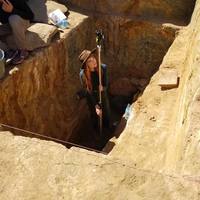
Christina M Carolus
Postdoctoral Scholar at the Spatial and Historical Network Dynamics Laboratory (SAHND) at The Pennsylvania State University. Recent Ph.D. at Yale University and research affiliate of the BioArCh Research Centre, University of York (UK). 2015 UC Berkeley graduate (B.A. Anthropology).
Interests include human-environmental and human-animal interaction, paleoethnobotanical and zooarchaeological methods, paleoecology, domestication processes, foodways, identity, trade and exchange, archaeological theory and ethics, archaeological scientific methods development, and cultural heritage issues. The full scope encompasses a range of other areas within the human, material, and environmental sciences.
My archaeological research is mainly paleoethnobotanical in orientation. It has included projects in Belize, the Central and Southern Andes, and Polynesia, but currently focuses on several projects across central and eastern Eurasia (Mongolia, Kazakhstan, Kyrgyzstan). The Mongolian steppe forms the geographical core of my research.
I am former co-director a multi-year archaeological project situated in the Gobi-steppe of southeastern Mongolia, where I conducted excavations and specialized paleoethnobotanical research concerning the relationships between emergent social complexity, dietary/subsistence economic transitions (e.g. introduction of plant and animal domesticates), and paleoecological shifts within Mongolia from the Late Neolithic through the Xiongnu Period. My dissertation research employed a targeted set of multiscalar analyses (macrobotanical analysis, stable isotopic analysis, lipid residue analysis, and paleoproteomics) on a range of materials in order to investigate these complex relationships.
I am currently the director of the Khulunbuir Archaeology Project, which centers on the site of Khairt Suuryn in northeastern Mongolia. Khairt Suuryn represents one of a few known Iron Age semi-subterranean settlements and has yielded new archaeobotanical evidence of early agriculture and aquatic resource exploitation on the Mongolian steppe.
Other recent research focuses on archaeological chemistry as applied to materials sourcing, faunal analysis, and methods development. This includes the use of x-ray fluorescence-based geochemistry to source lithic farming implements used by several of West Asia's earliest known agricultural communities (see Frahm and Carolus 2022). It also includes stable and radiogenic isotope-based analysis and sourcing of bone, carbonized plant remains, and ancient textiles from sites across Eurasia, as well as projects designed to expand ZooMS reference databases for central and eastern Eurasia.
Personal website: christinacarolus.com
Supervisors: Dr. William Honeychurch, Dr. Ellery Frahm, Dr. Jessica Hendy, Dr. Oliver Craig, Dr. John "Mac" Marston, Dr. Ann Underhill, and Dr. Jessica Thompson
less
InterestsView All (63)
Uploads
Papers by Christina M Carolus
We welcome papers addressing any topic and temporal sequence of archaeological interest, based in any geographical area, and engaging with any methodological and/or theoretical framework. IJSRA encourages submissions of papers such as:
• Research articles (up to 6,500 words).
• Literature reviews and academic essays (up to 5,000 words).
• ‘Debate’ articles based on unpublished or published evidence and that may challenge traditional, long-established academic perspectives (up to 6,000 words).
• Condensed field reports or monographs (up to 4,000 words).
• Reviews of Books relevant to the discipline, or Reviews of archaeological conferences, focusing particularly on the role and participation of students.
The International Journal of Student Research in Archaeology does not charge any submission or publication fees. Authors must confirm that the content of their original research papers has not been published or accepted for publication elsewhere (although previous presentation in poster format and at conferences is accepted).
All submissions should be full papers written in English or another field-relevant language. If the paper is submitted in a language other than English, an extended summary in English must be provided. Assistance with academic English of publishable articles will be provided if required.
The recommended deadline for submissions for our next issue is 15th March 2017. Please note that we are also accepting submissions on a rolling basis throughout the year.
If you have any questions, please do not hesitate to e-mail us at: [email protected]
IJSRA by Christina M Carolus
Gonzalo Linares Matás - Presentation of the third issue of IJSRA
Interview
Cherene de Bruyn, Jacqueline Jordaan - Regional feature: Perspectives from southern African archaeology professionals
II Articles
Valletta Verezen - The Crumbling Wonder: A damage- and risk-assessment of sandstone monuments and natural features in the Petra Archaeological Park (Jordan)
Frances Koziar, Camilo Gomez - From Colonialism to Nationalism, the Indian to Indigenismo: A History of Central Mexican Archaeology
Dannielle Croucher - Quantification of Interpersonal Violence in Skeletal Remains from Medieval and Post-Medieval London
Amanda Padoan - Gendering the Traces
III Conference Reviews
Rebekah Hawkins, Jacqueline Matthews, Francesca McMaster - Australian Archaeological Association 2016 Conference Review
Barney Harris, Dannielle Croucher, Hayden McKee - The 3rd Neolithic and Early Bronze Age Research Student Symposium, UCL
IV Book Review - Ariane Maggio
Review of Crowder, C. & Stout, S. D. (eds.) 2012. Bone Histology: An Anthropological Perspective
Chapters by Christina M Carolus
doi:10.1007/978-3-319-16999-6_3693-1